
Did you laugh while trying this coordination exercise?
It might have been easy for some of you. If it was, trying doing it with your eyes closed.
Could you do it with a sense or feeling of ease rather than struggle or a lot of effort?
For the rest of us who may have teetered or tottered, let’s break it down another way.
Breakdown of this coordination exercise movement
While you’re sitting on a surface, you let one knee bend out to the side, while the other knee is bent out in front of you.
It doesn’t matter if your knee (which is bent out to the side) is jacked up in the air. You do what you can with what you got.

Grab a hold of the foot of the knee which is not bent out to the side.
You get a hold of that foot with both hands.

If you can’t reach the foot, then it’s ok to hold the ankle, above the ankle or somewhere on your lower leg.
Then you start to move towards the knee that is on the surface or near it.
But, instead of going for it like you initially might have tried…

STOP HERE Instead.

Then you begin to reverse course.
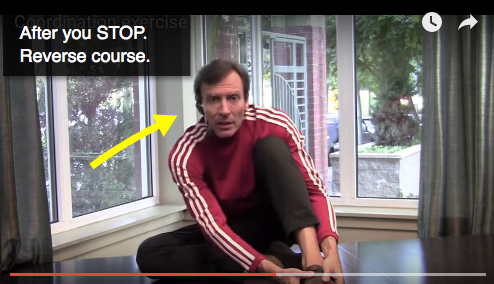
Then once you get back to where you started.
STOP Again.

When you move again.
“IF”
If moving over that far was a bit of a struggle. Then on the next attempt you can either move less or try it again.
When you do it again, try and feel as much as you can in terms of where the effort is coming from.
If it wasn’t a struggle, then move out only that far (just a little ways). See if you can make that smaller movement with a slower and smoother return.
Next Move
So now that you’ve got the idea.
“If’ you want to venture out a little further, then go ahead and move a little further out or towards the floor.
Remember you don’t have to.
You could “think” about going further out when you reach your comfort zone of that movement.

Once again, stop if you ventured out a little further either physically or mentally in your mind’s eye.
Then reverse course and…

This is where the goods are at.
By feeling what in the heck is going on.
Like any of the shifts or wobbles.
Now you’re using your brain to “watch” and/or “feel” what is going on.
Rest again.
Then if you’re comfortable or you wanna check it out.
You can go for it. (In your mind’s eye too).

Then when you reverse course…

Once again “feel” as much as you can.
What muscles are you using?
Where do you feel all the action happening?
If you wobble or weeble on the way back, that’s ok.
By the way… Were you holding your breath or gritting your teeth to “do” the movement?
The Other Side
So when you go to the other side.
Keep in mind you don’t have to go for it… unless you want to.

If it’s hard or a struggle on the other side…
Then either do less.
Or “think” you can and simply feel whatever you can as you do or imagine that particular movement taking place.
Coordination Exercise for Natural Flexibility
First, a movement which looks easy takes a lot of:
- coordinating actions
- a good sense of mobility
- and natural flexibility.
Mobility, is the ability to move easily or freely.
This is what sets up an ability to remain comfortably flexible.
Things have got to start moving first before any of us can reach certain states of flexibility.
The way we do this with somatics exercises – which is the reverse to most approaches out there – has more to do with the brain and body.
See, we achieve natural flexibility by not stretching.
We are targeting the brain in a precise manner so you can feel as much as you can using feedback loops like your sensory-motor system.
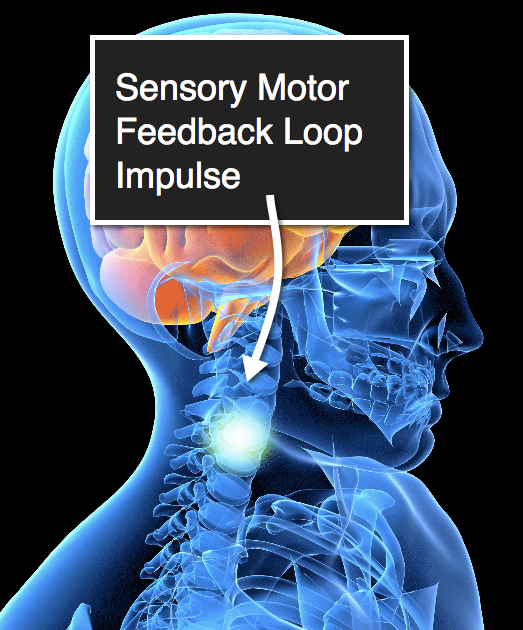
Since the brain communicates to the muscles, we get the muscles to be more adept at their jobs by reprogramming the brain’s software.
This brain update allows us to use a more refined level of mobility, so flexibility is more easily maintained.
So if you’ve got your mobility and flexibility, then coordinating movements or exercises like this one, can be relatively easy.
No struggle, no fuss.
Effortless Movement
So what appears as effortless movement is a brain and body event.
Many of us can do it or get back to it by working with the brain and body. This is what our Classroom helps people discover.
Since ALL the healthy vertebrate animals…pandiculate.

We take things a step further by applying more conscious attention.
Developing or redeveloping the ability of effortless movement can be gained using the brain’s intent to do or imagine certain specific movement patterns.
For example, the coordination exercise is a kind of a higher level somatics exercise.
This would be something we’d do at the end. First, we’d explore or break it down so we can build up to it.
Though it’s good to test it out first to see and feel where you are at.
Coordination Exercise to Build Strength
You can naturally and quickly develop the requisite strength by setting up the building blocks of movement so a coordination exercise such as this one… becomes effortless.
While it might feel as if you gotta give it some oomph. Strength can be achieved in many ways.
Somatics exercises lead us down this path as we need the requisite freedom in movement of our smaller muscles to move the larger ones.
Then we can more fully appreciate different levels of easy coordination on the way back to recapturing lost or forgotten abilities.
Somatics Exercises Coordination Class
Somatics exercises were initially designed to help people overcome all sorts of pain from all sorts of activities.
Even if we’re in the couch potato group – which don’t get me wrong – I love lounging out too.
Easy, gentle movements, which are broken down into manageable parts, paves the way for easier movement overall.
Conscious movement done with a simple 3 step method – frees the body so comfort returns again and again.
We’d love for you to join our freeing the back, hamstrings, coordination class where you’ll get the chance to see and feel how your hamstrings and back will lengthen, when done in a specific conscious manner.
Plus, you’ll learn the simple trick of knowing what to use to make this coordination movement feel and look easy.
So, let me know if this somatics coordination exercise movement was easy or a bit of a laugh.
